Search This Blog

Friday, 12 November 2010

Schedules

A lot of my filming took place either on lunch times at college or during half term / out of school hours. My plans often had to change due to last minute decisions but I did try making schedules.
I knew the deadline was DECEMBER so I put a lot of effort into the post-production work at home, in my own time.

I set my own mini-deadlines which helped me to keep on track, although, I wasn't always focusing on one thing at a time. For example, whilst writing my script, I started drawing my storyboards. And, whilst I began my editing, I was also continuing my filming as I wasn't able to film as much as I wanted within the time I had. My ancilliary texts were also being researched and created in the free time that I had when I couldn't use the editing suites to edit my film.

Week Start: 25th October
COMPLETE SCRIPT
Week Start: 1st November
COMPLETE STORYBOARDS
Week Start: 8th November
COMPLETE ANIMATIC
Week Start: 15th November
FILMING
Week Start: 22nd November
FILMING
Week Start: 29th November
EDITING
Week Start: 6th December
EDITING
Week Start: 13th December
Evaluation
DEADLINE - THURS 16TH DECEMBER

Monday, 8 November 2010

Problems

Throughout my planning stages I experienced many problems...

- Cast. I found it difficult when some members told me they didn't want to be in my film when I had already done most of my planning. This made it hard, not only because I had to alter my script but also to try and find other people to fill their places. Luckily I had volunteers within a few days.
- Script. I learnt that my original script wasn't in the correct form so had to research and create a shooting script instead. Though it only took me another week to change, it did cost me a week of the time I was planning on my storyboards.
- Locations. Originally, I was planning on shooting a couple of scenes (the end scene and the cinema scene) on location. So for the cinema scene I would have an establishing shot of Cineworld but then I realised that I needed permission. Likewise, for the ending, I originally planned to shoot in the town center at the bus station but again I'd need permission and wouldn't be granted it. I think it would also have been too busy and there would have been people who wouldn't want to be filmed or people who would interrupt the filming.
Below is the letter to Cineworld asking permission to film.

- Schedule. It was difficult trying to make sure that everyone was availible for filming and booking the camera/location (such as the theatre). Everyone had different timetables or other commitments and I didn't want the filming to interrupt their studies. So time was an issue as I didn't feel like I had enough for what I had planned.
- Storyboards / Pictures. In the storyboards / pictures, I had to substitute the people I was originally filming to take the photos as they were often unavailible at the times I needed them. This didn't make it confusing for me though as I knew who the scene involved and could picture them clearly. The photos were only to give a basic understanding of what the shot would look like and where my characters would be.
- Window Scene. I had many problems with this scene. Unfortunately, I decided to disclude it from my finished product as not only did I have problems with reflections, but it also made my short film a lot longer than I'd originally intended. Another issue was that it would also need re-shooting and I would've struggled with time issues if I'd of done that. I was disappointed that I couldn't include it as I thought it looked really good in Taylor Swift's music video, You Belong With Me.

Friday, 5 November 2010

Actual Idea (6) - Animatic

For my animatic, I put all of my pictures in order. There are some hand-drawn images as I couldn't take photos of the shots so drew them instead. I used the music which I'm planning to use in my final product but the dialogue over the top isn't by the original cast. Because it was difficult finding time to meet up to do the voice-overs, my friend Matt helped me out again, and I filled in for Shannon's lines.


I used Windows Movie Maker to create my animatic, but unfortunately it wouldn't allow me to have more than one audio layer, so I couldn't put my music along with my dialogue. However, I only have two sections of music. To open my film, I have the guitar version of Love Story playing through my intro credits until the end of the picture of Jonny playing the guitar. The next piece of music begins when Marc slams the door in Jonny's face and the piano version of Love Story plays until it slowly fades out when the car turns around the corner (aka the picture before Jonny's voice over) before resuming again for the credits.


Thursday, 4 November 2010

Actual Idea (5) - Music

For the music I decided to use Taylor Swift's song Love Story as it tied in nicely with my research on her music videos. It's also easily recognised, coming #4 in the Billboard Hot 100. The lyrics also can apply to the narrative of my story, taken from wikipedia, Taylor Swift said:
"This is a song I wrote when I was dating a guy who wasn't exactly the popular choice. His situation was a little complicated, but I didn’t care. I started this song with the line, 'This love is difficult, but it's real.' When I wrote the ending to this song, I felt like it was the ending every girl wants to go with her love story. It's the ending that I want. You want a guy who doesn’t care what anyone thinks, what anyone says. He just says, 'Marry me, Juliet, I love you, and that's all I really know.' It's sort of told in a character kind of thing, where it's Romeo and Juliet, and it's not me saying that I'm getting married or anything...but I think it's fun to write about it."
In my short film, the male character isn't the "popular choice" which is why the female's father stops them from seeing each other. Despite wanting that "love story ending" my film doesn't end in that way and instead has an unexpected sad departure of the two characters.
However, I'm not using Taylor Swift's version of her song. On YouTube I found a beautiful piano version of her song by someone called TruePiano1. I asked permission to download it and use it in my short film and he granted it.
Here is his version of it:


I thought I could keep the music choice of Love Story consistent throughout but change the instruments playing it. Luckily, I had a friend and his sister (Matt and Rebecca) who are musical and could play Love Story on guitar. I'm hoping that Rebecca will also sing the end verse of the song which goes:
"I got tired of waiting, wondering if you were ever coming around,
My faith in you was, fading,
Then I met you on the outskirts of town ..."
I think this adds to the solemness of the end of my film when Jonny is looking for Shannon. It can also be interpreted that this is how Shannon feels and we get to see her point of view in this situation.

Though it isn't really music, I'm hoping to try and find a horror film sound effect for in the cinema which will help to make the scene more realistic. For the sound effects, I'm looking on the website http://www.freesound.org/ which has many effects availible for download. I've found a few files which I'm going to download and because the site is free I need to mention the creators name in the credits of my film.

Actual Idea (4) - Photos

I took many photos, not only to get test shots which would help me to see whether that was the right filming location, but also for my storyboards which meant I didn't need to draw them! There were so many that I decided to make an animation of them all from each scene. I didn't take photos for every scene as I could only get to certain locations once so filmed immediately when I got there instead and drew the storyboard pictures instead. Locations did also change due to different circumstances but these photos show some of my original ideas.


There were some issues with the photos, especially Scene 15. This was the window scene and it was extremely difficult.
This is a picture I took and unfortunately shows too much of the background in the window. I didn't realise that there would be lighting issues and because we took the photos during the day, the sun's glare reflected more of the background on to the window so I couldn't see Shannon who was inside as clearly as I wanted. I then decided that I would film during a night which did work better except that we had to use extra lights outside to show Jonny. (This will be further explained in another blog...)

Wednesday, 3 November 2010

Actual Idea (3) - Storyboard

For my storyboards, I also decided to do some research into it. I knew how to set out a storyboard from GCSE Media but I wanted to be sure that it was properly designed and had everything that was needed.

Key Points :
- lays out narrative of the whole film in visual form
- visually tests out transitions between scenes
- shows production team how many must-have shots you need so that a schedule can be planned. Also allows the designers to determine how long they will need to secure a location for.
- whether shots deviate from the script
- visual for actors to work off
- demonstrates how many shots and the variety of shots used
- 'test' locations

Storyboards are a key part to the Location Scout's job. They use the storyboards to find locations suitable enough that will fit well with the concept.
Location Scout and what they look for :
- concept and aesthetic requirements - does the location fit the ideology that the film is trying to communicate?
- ambient sound (traffic, birds etc...) - will this fit well with the concept or interrupt the filming?
- light conditions - too bright or too dark will influence whether extra screens or lights will be needed.
- coverage / cinematography - does the mise-en-scene fit well with the concept? and is there cover from the weather elements?
- site locations compared to other locations - if there is a better or more suitable location then comparisons need to be made to get the best space.
- parking / facilities nearby - food and toilet facilities are important, if there aren't any availible then arrangements need to be made. Is there enough parking for all the crew and trucks?
- cost - an important part, film budgets can vary and especially for a low budget film, it's critical to save any money possible.
- availibility of power - power is needed for cameras / lights and anything electrical so there needs to be access to power or arrangements need to be made for generators.
- exterior location, weather / lighting - will the weather / lighting interupt the filming or add to the mise-en-scene?
- permission - is it needed? if so it needs to be granted in advance.
VERY TIME CONSUMING AND COMPLEX! which is why the storyboards and planning needs to be done in advance and in plenty of time so that if need be, a change of location can be drafted and adapted in to the plans.

I decided to draft out a blank storyboard and then copy it on to the computer. It looked like this:


Because I'm not a very good drawer, I decided on taking photos for my storyboards which not only made it quicker but also meant I could get more of a visual image from the test shots. This helped later with my filming. However, one issue was that the people portraying my characters weren't always availible so I had to use stand-ins for them. I was also going to upload all of the storyboards seperately, but it made it easier to just put them all together as one file. I did have a problem with uploading them as after I'd scanned them, for some reason the computer didn't show them as jpeg. or image files, so I had to take photos of them with a camera and upload it that way!

Tuesday, 2 November 2010

Actual Idea (2) - Script

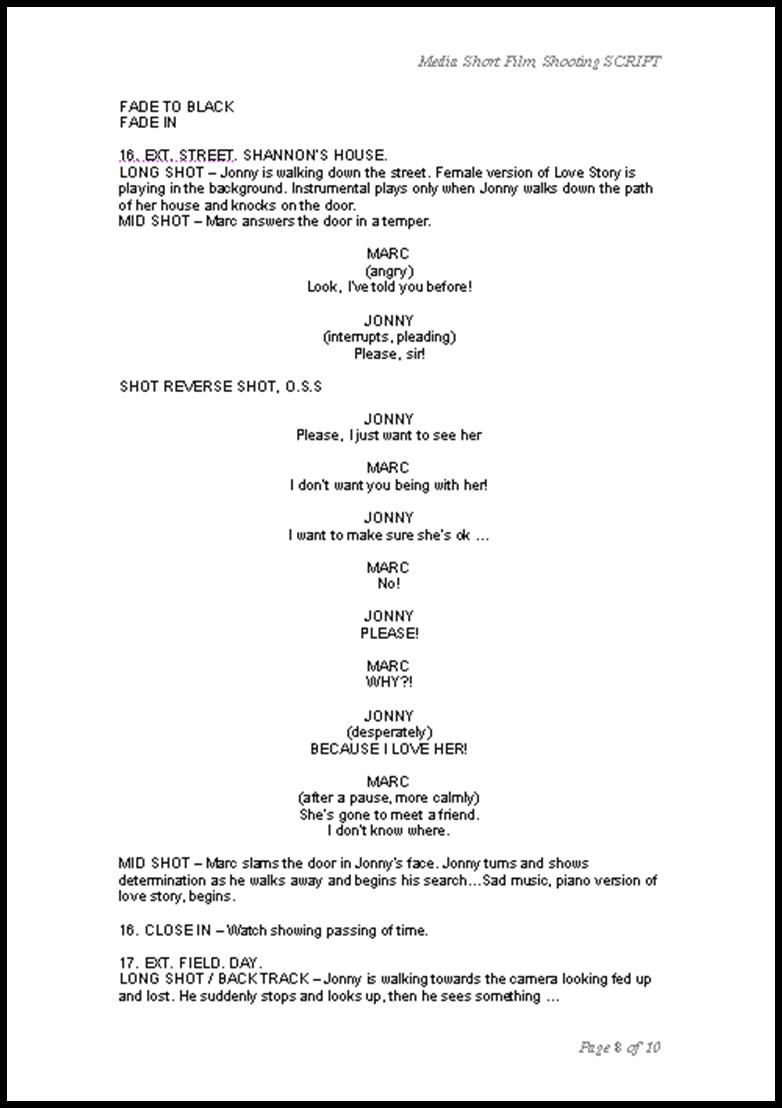
Originally, I decided to write a script to get a basic understanding of the variety of shots and narrative my short film will follow. I firstly drafted my ideas just writing it all out before typing it up on the computer to make it neater and more understandable. On the original copy, "Shannon" was "Jess" but I was able to amend this easily with a simple 'find and replace' option.


I then realised that I needed to create a Shooting Script and because I was unfamiliar with the layout, I decided to research into it before adapting my original script into a shooting script.


RESEARCH (taken from the book "Basics, Film-Making by Robert Edgar-Hunt"):
Conventions for a shooting script;
- script is presented as a final draft. No page number ammendments.
- header with the date and script reference.
- scenes are numbered alongside headers.
- (CONT...) is used at the bottom of a page where dialogue / scene continues over to the next page.

Pages:
- when amendments are made, you need to produce these on revision pages. These are additional sheets. It's more easy to slip between versions without the catastrophic effects later in the shoot.
- if your changes move beyond a single page then they begin to be marked A, B, C ...
- if you delete a page of script then issue a blank page with 'DELETED' or 'OMITTED' on it, otherwise that rogue page might stay there in error.
- when you issue revisions, it is convention to do so on different coloured paper each time to give a quick visual clue.
- when a line is changed, it is worth noting it with an asterisk in the far right.
Scenes:
- when a scene is added, do not change the scene numbers, use A, B, C ...
- if a scene is removed, mark it as 'DELETED' or ' OMITTED' and never reuse the scene number.

Script Considerations:
- Who are the characters?
- Are the characters characterised correctly?
- Is the tone of delivery of speech clear?
- Do the physical descriptions of characters work?

- Are settings / locations fully explained and explored?

- Are there any subtexts that you need to explore or draw out?
- What is the central theme or meaning?
- What is the cause and effect relationship between events?
- Do the scene transitions work effectively?
- What is the plot?


Also for my research, I looked at an example of a screenplay, taken from the same book. I decided to type it out which has helped me with how I should be setting mine out.


My shooting script turned in to 10 pages long from the original 7. I kept the scripts almost identical with minor changes throughout, i.e. instead of shot reverse shot constantly I kept with a mid-shot or over-the-shoulder shot.